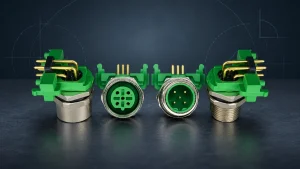
A waterproof circular connector is a sealed, cylindrical electrical interface rated IP67 or IP68 under IEC 60529, built to keep moisture, dust, and contaminants out of mated power and signal connections. IP67 handles temporary immersion to 1 meter for 30 minutes. IP68 covers continuous immersion at depths and durations defined by the manufacturer. The right choice depends on three variables: ingress protection level, sealing method (O-ring, gasket, or potted), and locking style (threaded, push-pull, or bayonet).
What a Waterproof Circular Connector Actually Is
The housing is round. The contacts sit inside an insulator block. A sealing element — usually a fluoroelastomer O-ring — compresses against the mating face when plug and receptacle are joined. That compression is what creates the IP rating. Remove the seal, and the IP rating is gone, even if the connector body looks identical.
Two specifications matter most at the procurement stage: the IP code (water/dust ingress) and the contact rating (current, voltage, mating cycles). A connector rated IP68 with 500 mating cycles is built differently from one rated IP68 with 5,000 mating cycles. The first is a fixed-install part. The second is field-service equipment. Buyers often confuse them.
IP67 vs. IP68 vs. IP69K: a Procurement-Level Breakdown
The numbers come from IEC 60529, the international standard for ingress protection. The first digit covers solids. The second digit covers water.
IP67 — dust-tight, immersion to 1 meter for 30 minutes. Suitable for outdoor enclosures exposed to rain, splash, and short submersion (cleaning cycles, washdown, rainfall). Most factory automation, outdoor LED, and agricultural electronics specify IP67.
IP68 — dust-tight, continuous immersion at conditions specified by the manufacturer. The depth and time vary. Some IP68 connectors hold seal at 1.5 meters for 30 minutes. Others hold at 20 meters for 24 hours or longer. Always read the datasheet. “IP68” without a depth/time spec tells you nothing useful.
IP69K — pressure-jet washdown, 80 °C water at 80–100 bar. IP69K terminology is associated with ISO 20653 for road vehicles; IPx9 is included in IEC 60529. Specify this when the connector lives on a dump truck, food-processing line, or anything that gets steam-cleaned.
Common Waterproof Circular Connector Types
The market clusters around a handful of standardized form factors. Each carries its own current envelope, locking style, and typical industry footprint.
M-Series (M5, M8, M12, M16, M23)

Metric thread standard, screw-locked, defined under IEC 61076. M12 dominates industrial automation and fieldbus protocols (Profinet, EtherCAT, IO-Link). M23 covers servo motors and higher-current signal/power hybrids.
Push-Pull
One-handed mating with audible click confirmation. Up to 114 contacts in compact shells. Standard in medical, broadcast, and high-cycle field instruments.
MIL-DTL-38999 / MIL-DTL-26482
Bayonet or threaded coupling, salt-spray rated, EMI-shielded backshell options. Used in defense, aerospace, and high-reliability industrial applications.
Mini-Circular (e.g., AMP CPC)
Cost-balanced sealed circular for vehicle and outdoor industrial wiring harnesses. IP67 mated, lower unmated. Typical for trucking, off-highway equipment, and outdoor machinery.
Waterproof Circular Connector Selection Matrix
This matrix narrows the shortlist before you pull datasheets. Verify each row against the manufacturer’s documented test conditions.
| Connector type | IP rating (mated) | Lock | Typical current | Pin count | Primary use |
| M5/M8 | IP67 | Screw | 1-4 A | 3-8 | Compact sensors, miniature automation |
| M12 | IP67/IP68/IP69K | Screw | 4-12 A | 3-17 | Industrial fieldbus, IO-Link, sensors |
| M16 | IP67 | Screw | 5-10 A | 2-24 | Instrumentation, control panels |
| M23 | IP67/IP68 | Screw | up to 30 A | 6-19 | Servo motors, encoders, drives |
| Push-pull | IP50-IP68 | Push-pull | 1-50 A | 2-114 | Medical, broadcast, field test, instrumentation |
| Bayonet (MIL-spec) | IP67/IP68 | Bayonet | varies by shell size | up to 128 | Defense, aerospace, heavy industrial |
| Mini-circular (CPC) | IP67 mated | Push-snap | 5-25 A | 2-24 | Vehicle harnesses, off-highway, outdoor industrial |
Final selection comes down to four variables not shown in the matrix: mating cycle count, operating temperature range, contact plating, and unmated IP rating. The matrix shortlists; the datasheet decides.
Sealing Materials And What Fails
Waterproof circular connectors fail at the seal long before they fail at the contact. The materials decide the service life.

Housing: zinc alloy, brass, stainless steel, or glass-filled thermoplastic. Stainless 316 is the corrosion-resistant default for marine and offshore. Zinc alloy with nickel plating is the cost-balanced standard for industrial use. PA66 with 30% glass fiber works for cost-sensitive automotive and lighting.
Insulator: PBT, PEEK, or LCP. PEEK handles 250 °C continuously. PBT is the workhorse for general use. LCP is specified for fine-pitch, high-density designs.
Seal: silicone for general weather, fluoroelastomer (FKM/Viton) for chemical and high-temperature, EPDM for steam. Silicone is the default and fails first when fuel or solvent is present. Don’t substitute on price.
Contacts: phosphor bronze or brass, plated with nickel underplate plus gold or silver. Gold over nickel is the long-life signal contact. Silver is for high-current power contacts where oxidation tolerance matters less than conductivity.
Locking Mechanisms — What Each One Is Good At
The mating mechanism determines vibration tolerance, mating speed, and unmating safety.
- Threaded coupling (screw lock): highest vibration resistance, slowest to mate. Standard on aviation-style connectors and M-series. Used in industrial automation, machine tools, and outdoor cabinets.
- Bayonet: quarter-turn lock with a positive stop. Faster than a screw, vibration-resistant. Common in military and heavy equipment.
- Push-pull: one-handed, fastest to mate and unmate, audible click confirms lock. Used in medical, broadcast, and field-deployable equipment.
- Quick-connect/snap: tool-free, fastest of all, lower vibration tolerance. Used in lighting, sensors, and short-cycle field assembly.
Match the locking mechanism to the operator and the environment. A medical tech disconnects a connector hundreds of times a week; a wind-turbine connector mates once and stays mated for 20 years.
Industry Applications — Where the Spec Actually Changes
Industrial Automation
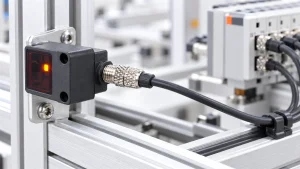
IP67 minimum, screw or bayonet lock, –40 °C to +85 °C, salt spray tested. M12 is the waterproof circular standard for industrial automation under IEC 61076-2-101 — typically 4-pin for power, 5-pin for fieldbus, 8-pin for Ethernet, and IO-Link. Pre-terminated M12 cable assemblies for industrial automation eliminate field-stripping errors on sensor and actuator runs and shorten line installation time.

Outdoor Lighting And Renewables
IP67 or IP68, UV-stable housing, low insertion force for fast field assembly. Solar junction-box connectors and street-lighting harnesses sit in this category.
Marine And Offshore
IP68 with 316 stainless or marine-grade brass, fluoroelastomer seal, salt-spray rated to 1,000 hours per ASTM B117.
Medical
Push-pull lock, autoclavable silicone seal, low contact resistance, often custom keyed to prevent miswiring.
EV And Charging Infrastructure
High-current circular contacts (RADSOK or similar), IP67 mated and IP55 unmated, with the unmated rating controlled by a sealing cap. Buyers should require both ratings on the datasheet.
Rail And Transportation
EN 50155 compliance plus IP67/IP68. Vibration class is the differentiator here, not just ingress. Rolling stock and trackside applications often require non-standard pin layouts, EN 50155-graded vibration tolerance, and shell configurations that catalog parts do not cover. The custom solutions handle these rail-specific waterproof circular connector builds with tooling support and prototyping for low-to-mid volume runs.
Selection Checklist for Procurement
Before issuing an RFQ, confirm the following on the datasheet:
- IP rating with depth and duration — “IP68 at 2 m for 24 h” is a real spec; “IP68” alone is not.
- Mated and unmated IP — many connectors lose ingress protection when separated. Ask for both.
- Current and voltage — per contact, not aggregate. A 10-pin connector rated 5 A per pin is not a 50 A connector.
- Mating cycles — 500 for fixed install, 5,000+ for field service.
- Operating temperature range — minimum and maximum, plus thermal shock if cycled.
- Material certifications — RoHS, REACH; UL 1977 for power; IATF 16949 for automotive.
- Coupling style — match to vibration profile and operator workflow.
- Cable compatibility — the outer diameter range of the strain relief must match the cable jacket.
- Salt spray hours — 96 h baseline, 500–1,000 h for marine.
- Lead time and MOQ — verify against your production schedule before locking the spec.
FAQ
Conclusion
Specifying a waterproof circular connector for application is a matching exercise: IP rating to environment, locking mechanism to workflow, material to chemical exposure, contact rating to electrical load, and form factor to industry standard.
The biggest sourcing mistakes are accepting an IP68 claim without a depth/time figure, ignoring the unmated IP rating, and underestimating mating cycles. Read the datasheet line by line. Pull samples. Test against the actual installation, not the lab assumption. Manufacturers who publish specific test conditions and full material certifications are the ones to short-list.