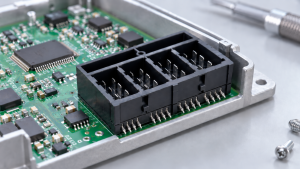
In electronics, tiny parts sometimes matter a lot. Chances are you’ve seen basic square pins loads of times – they hook up stuff on circuit boards pretty much every day. Yet if things need to stay solid under stress, you might switch to their sharper relative: the round pin header.
Here’s the thing – how do they actually differ, or does paying more for round pins even matter?
This guide gives a clear breakdown so you can see what sets each kind apart – picking the fit for your setup becomes way easier. From manufacturing details to real-world performance, we go over it all.
Understanding the Fundamental Difference: Manufacturing Process

The main gaps in speed, durability, or price when comparing round versus square pins depend on the way they’re made – shaped by production methods rather than design alone.
Square Pin Headers (Stamped and Formed)
Regular square pins get created fast using an affordable method known as stamping plus shaping. A device grabs a thin metal strip – typically brass – and knocks out extended rows of pin shapes at once. After that, they’re sliced into individual pieces.
- Formed by pressing a thin metal piece into shape.
- Super cheap plus easy to find everywhere. Most folks pick them ’cause they don’t cost much.
Round Pin Headers (Machined or “Swiss” Pin)
A round pin header connector is made using a completely different, higher-precision method. Each pin is individually tooled on a lathe, essentially “sculpted” from a solid rod of metal stock into a perfectly cylindrical shape.
This process is often called “Swiss-machining” due to the precision lathes historically made in Switzerland. The female socket contact is often called a “tulip” contact because its multi-fingered design looks like the flower.
- Process: Lathed/machined from solid metal stock.
- Result: Higher precision, greater strength, and a smoother surface finish. This process is slower and more expensive, which is reflected in the final price.
Round vs. Square: A Head-to-Head Comparison
Let’s break down how these manufacturing differences impact real-world performance. This table gives a quick overview of the key trade-offs.
| Feature (Test Standard) | Machined Round Pin Headers | Stamped Square Pin Headers |
|---|---|---|
| Contact Resistance | Usually < 10mΩ | Typically 10mΩ – 20mΩ |
| Mating/Unmating Cycles | > 500 cycles (high-end up to 1000) | ~50-100 cycles |
| Insertion/Retention Force | Insertion: High, Retention: > 1N per pin | Insertion: Low, Retention: < 0.5N per pin |
| Vibration Resistance (e.g., MIL-STD-202G, Method 204D) | Passes; No discontinuity > 1µs | Prone to failure or intermittent contact |
| Current Capacity (Single Pin, at 20°C rise) | 3A – 5A | 2A – 3A |
| Cost | Significantly more expensive. | Very inexpensive. |
| Compatibility | Mates with round sockets only. | Mates with square sockets only. |
Mechanical Connection & Reliability
This is where the round pin header truly shines. When a machined male pin enters a matching female round pin header (the “tulip” socket), its smooth, cylindrical shape engages multiple points of contact. This results in a much higher insertion and retention force.
This resilience isn’t just a qualitative feeling; it’s a measurable attribute verified against rigorous industry benchmarks. For example, the MIL-STD-202G, Method 204D vibration test is a standard procedure used across the mil-aero industry to subject components to intense, varied-frequency vibrations. Connectors that pass this test, like machined round pins, are proven to prevent signal loss and physical failure, a critical requirement where stamped pins often fall short. You can review the test parameters for this standard on the Defense Logistics Agency website.
Electrical Performance
More contact means a better electrical connection. The multi-finger contact design of a machined socket provides a larger surface area against the male pin. This leads to lower contact resistance and, as a result, a higher current-carrying capacity compared to a standard square pin of the same size. This is determined by measuring the temperature rise of the pin as current passes through it. A machined pin’s lower contact resistance (often measured with a four-wire milliohmmeter) generates less heat, allowing it to handle more current before exceeding its thermal limits.
Compatibility & Mating
This is a critical point that can save you from damaging expensive components.
The Golden Rule: Round mates with round, square mates with square.
Never try to force a square male pin into a round female socket. The sharp corners of the square pin will permanently stretch and destroy the delicate, multi-fingered “tulip” contact inside the machined socket, ruining it forever.
Conversely, putting a round pin into a standard square socket will result in a very loose, unreliable connection that is likely to fail.
Cost
There’s no contest here. The stamping process for square pins is incredibly efficient, making them one of the cheapest connector types available. The precision lathing required for round pins is much slower and more material-intensive, making them significantly more expensive. A single machined pin header can cost more than an entire strip of square ones.
Application Guide: When to Use Round Pin Headers
So, given the trade-offs, how do you decide?
Use Round Pins For:
- High-Reliability Systems: Aerospace, military, and medical equipment where connector failure is not an option.
- Industrial Environments: Machinery subject to constant vibration, shock, or temperature cycles.
- Production Hardware: For final products where long-term durability and a secure connection are critical.
- Socketing Expensive ICs: Using machined pin sockets is a great way to protect delicate and expensive ICs. The lower insertion force and more reliable contact prevent both pin damage and poor connections. A common combination is to use a double row round pin header socket for DIP-package microcontrollers, a solution that SOULIN specializes in providing.
- Test Fixtures and Programmers: When a connector will be mated and unmated thousands of times, the durability of a machined pin is essential.
Use Square Pins For:
- Prototyping and Development: Perfect for breadboarding and creating initial designs where cost and availability are key.
- Cost-Sensitive Consumer Electronics: When every penny counts and the application is not subject to harsh conditions.
- General-Purpose, Low-Vibration Applications: For the vast majority of standard electronic devices that sit on a desk or in a stable environment.
Terminology Guide
One reason round pins can be confusing is the variety of names they go by. If you see any of these terms, they are all referring to the same type of high-precision, lathed connector:
- Machined Pin Header (Most common industry term)
- Swiss Pin Header (Refers to the manufacturing method)
- Milled Pin Header
- Tulip Connector (Specifically refers to the shape of the female socket contact)
- Pin header round (Common search term)
Finding the Right Machined Pin Header for Your Application
Finding out what sets them apart comes first. After that, picking a fit based on correct spacing, number of pins, also coating matters for your build. Over at SOULIN, we’ve got plenty of super-accurate round pin connectors made for tough jobs. If it’s a basic one-line setup or something built just how you want, our tech crew can help get it done.
Industry Standards & Certifications
The quality and reliability of pin headers are governed by several key industry standards. When selecting a supplier, look for compliance with:
- ISO 9001:2015: Ensures the manufacturer has a robust quality management system.
- RoHS (Restriction of Hazardous Substances): Critical for products sold in the EU and elsewhere.
- REACH (Registration, Evaluation, Authorisation and Restriction of Chemicals): Another key European regulation concerning chemical safety.
- UL Certification (e.g., UL 94V-0 for housing material): Certifies the flammability rating of the plastic insulator.
SOULIN’s got ISO 9001 cred – check it out right here. Their gear meets RoHS rules, also sticks to REACH standards. Peek at the paperwork online if you’re curious.