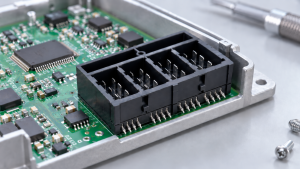
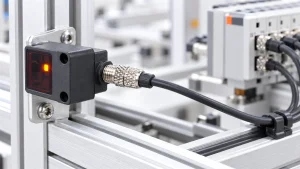
An M12 connector is a 12 mm metric circular connector used in industrial equipment for signal, data and power wiring. You will see it on sensors, actuators, field I/O modules, machine vision systems, outdoor control cabinets, compact power modules and automated production lines.
The connector body is only the starting point. A reliable M12 connection also depends on coding, pinout, voltage rating, current rating, cable material, shielding, sealing and installation quality. Two parts can share the same M12 thread and still belong to different electrical systems.
For engineers and purchasing personnel, the quickest way is to read the device port diagram before selecting cables or connectors.

The Soulin M12 Fit Stack
At Soulin, we check M12 selection in layers. We call this the M12 fit stack — a step-by-step selection workflow that confirms one requirement layer at a time: port, coding, pinout, rating, cable, environment and assembly. It is a way of ordering the selection process, not a physical stack of adapters or couplers. We use it because most failures happen when a layer is skipped. A connector may fit mechanically, then fail electrically. It may pass electrical checks, then fail in washdown. Working through the layers in order keeps RFQ review grounded in the real application.
| Fit Layer | What to Confirm | Why It Matters |
|---|---|---|
| Device port | Mating side, male or female interface, straight or angled body | The device port defines the connector family and physical direction |
| Coding | A, B, D, X, T, L, S, K or Y code | Coding prevents signal, Ethernet and power connectors from being mixed |
| Pinout | Contact function, conductor color and face view | Pin count alone does not define wiring |
| Rating | Voltage, current, insulation resistance and contact resistance | The same M12 size can carry very different loads |
| Cable | Jacket, conductor size, shielding, flex life and outer diameter | Cable design decides durability after installation |
| Environment | IP rating, oil, UV, chemicals, temperature and vibration | A connector inside a cabinet has a different job from one on a washdown machine |
| Assembly | Field-wireable connector or molded cable assembly | The decision affects installation speed, repeatability and repair method |
Use this stack before comparing part numbers. It also gives sales, purchasing and engineering a common language during RFQ review.
M12 Connector Types by Function
| Function | Common Coding | Typical Use | Main Selection Risk |
|---|---|---|---|
| Signal wiring | A-coded | Sensors, actuators, field I/O and automation devices | Matching the wrong pinout or conductor color |
| Industrial Ethernet | D-coded or X-coded | Controllers, cameras, networked equipment and data devices | Choosing the wrong data speed or unshielded cable |
| DC power | T-coded or L-coded | Field power, compact power distribution and distributed modules | Using a signal connector for a power circuit |
| AC power | S-coded or K-coded | Industrial power interfaces and compact equipment | Ignoring spacing, safety and voltage requirements |
| Hybrid wiring | Y-coded | Combined power and data in one interface | Mixing a hybrid port with a standard signal or Ethernet connector |
We supply M12 A, B, D, X, S, T, L and K coded connector options for sensors, industrial Ethernet, automation and power systems. For a code-by-code reference, see our M12 connector coding chart.
M12 Connector Coding Explained
M12 coding is the keyway design inside the connector. It controls which plug and socket can mate. The outer thread size stays M12, while the internal key shape changes by function.

If the connector does not mate smoothly, stop. Forcing the keyway can damage pins, break the insert or send power into a signal port.
| M12 Code | Common Use | Ordering Check |
|---|---|---|
| A-coded | Sensors, actuators, I/O modules, and general automation signals | Confirm pin count, sensor wiring, and face view |
| B-coded | PROFIBUS and legacy fieldbus systems | Check the fieldbus standard and device manual |
| D-coded | 100 Mbps industrial Ethernet | Match cable category, shielding, and port speed |
| X-coded | Gigabit and 10 Gigabit Ethernet, machine vision, and high-data equipment | Confirm that both the connector and the cable support the required data rate |
| T-coded | 24 V DC power distribution | Verify conductor size and current rating |
| L-coded | Compact higher-current DC power | Check the rated current by exact pin count |
| S-coded | AC power | Confirm voltage, safety spacing and equipment standard |
| K-coded | Higher-power AC equipment | Review full power specification before substitution |
| Y-coded | Power plus data in one interface | Use only when the device is designed for that hybrid layout |
M12 Pinouts and Pin Count
Pin count tells you how many contacts are inside the connector. Pinout tells you where voltage, signal, data, shield and ground land.
This distinction is crucial during maintenance. A buyer may request a 4-pin M12 cable because the damaged component has four contacts, but that information is still incomplete. A 4-pin A-coded sensor cable and a 4-pin D-coded Ethernet cable can fit completely different systems.
To make that concrete, compare the two 4-pin face views:
- 4-pin A-coded DC sensor: pin 1 (brown) and pin 3 (blue) usually carry power — +V and 0 V — while pin 4 (black) and pin 2 (white) carry switching signals. Two contacts power the device, two carry I/O.
- 4-pin D-coded Ethernet: all four contacts carry data. Pins 1 and 3 form the transmit pair (TD+ / TD−) and pins 2 and 4 form the receive pair (RD+ / RD−). No pin carries power.
Same pin count, completely different contact function. That is exactly why the face view and pin assignment decide compatibility, not the number of pins.
Common M12 layouts include 3-pin, 4-pin, 5-pin, 8-pin, 12-pin, and 17-pin versions. Lower pin counts are often used for simple signal or power wiring, while higher pin counts help save space when more conductors are needed.
Before ordering, check the product drawing carefully. It should show the connector face view to prevent mirror-image wiring errors, the pin assignment for each contact, the cable conductor color for maintenance replacement, and the electrical rating for the exact pin count. This prevents buyers from assuming that one rating applies to the whole M12 product family.
Soulin M12 Data Snapshot
Our public product pages show a useful selection pattern. M12 connectors that look similar from the outside can carry very different electrical ratings once pin count and code change.
| Soulin Reference Configuration | Published Data | Selection Insight |
|---|---|---|
| M12 8-pin X-Code male/female connector set | IP67/IP68, 30 V, 2 A, operating temperature from -40 deg C to 105 deg C, mechanical lifespan >=500 cycles | Best suited to high-speed signal transmission with limited current capacity |
| M12 5-pin L-Code cable-end connector set | IP67/IP68, 60 V, 4 A, PA66+GF housing, EPDM O-ring, gold-plated bronze contacts | A better fit for low-voltage power than a standard signal cable |
| M12 2-17 pin rear-lock panel connector | 2-5 pin versions can be rated 60 V and 4 A, while higher pin counts can drop to 30 V and lower current levels | More pins can reduce current capacity in compact connector layouts |
Electrical performance must come from the code and the rating table for the exact pin count.
Where Application Changes the Connector
The same M12 family can appear in a camera, a washdown machine and a DC power module. The selection logic changes each time.
| Application | What to Check First | Field Risk |
|---|---|---|
| Machine vision | X-coded connector, shielding, cable quality and data rate | Image data can drop frames when the cable system cannot handle bandwidth or noise |
| Industrial Ethernet | D-coded or X-coded port, cable category and shield termination | A network may connect physically and still fail at speed |
| Washdown equipment | IP rating, seal material, cable jacket and mating condition | Water, detergent and repeated cleaning can attack the cable as much as the connector |
| Outdoor cabinets | UV exposure, temperature range, condensation and strain relief | Sunlight, cold nights and cable movement age the assembly over time |
| Sensor and actuator wiring | A-coded interface, pinout, cable length and bend radius | A correct-looking replacement cable can leave the sensor unpowered |
| Power distribution | L, T, S or K coding, conductor size and current rating | Signal connectors should not be asked to carry power loads |
| Moving equipment | Flex life, molded strain relief and connector orientation | Repeated movement can break a cable that passed a static electrical test |
Waterproof and IP-Rated M12 Connectors
IP ratings should be treated as test conditions, not marketing labels. IEC 60529 defines the ingress protection framework, while manufacturer datasheets define the exact condition behind many IP68 claims.

IP67 usually refers to dust-tight protection and temporary immersion. IP68 refers to continuous immersion under conditions stated by the manufacturer. High-pressure, high-temperature washdown is where the standards diverge: IPX9 is defined within IEC 60529, while IP69K originates from ISO 20653 (formerly DIN 40050-9). The two tests are closely related, but because they come from different standards the labels are not automatically interchangeable. Always defer to the standard, pressure, water temperature, nozzle distance and duration stated on the datasheet rather than the IP label alone.
Our waterproof circular connector guide gives a procurement-level breakdown of IP67 vs IP68 vs IP69K. One point deserves special attention: an IP68 claim without depth and duration is incomplete.
Before approving an IP-rated M12 connector, confirm the following.
| IP Detail | Question to Ask |
|---|---|
| Mated condition | Does the rating apply only when plug and socket are fully mated |
| Test depth or pressure | What immersion depth or washdown pressure was used |
| Test duration | How long did the connector remain under test |
| Cable jacket | Will the jacket survive oil, UV, detergent or flexing |
| Seal material | Does the O-ring or gasket match the chemical and temperature exposure |
| Installation | Is torque, strain relief or potting required to maintain the rating |
Field-Wireable M12 Connectors and Molded Cable Assemblies
Field-connectable M12 connectors help installers cut cable lengths, repair damaged wiring, or adjust cabling during maintenance in the field. They offer flexibility and also shift quality control to the field. Stripping length, termination pressure, tools, and inspection all affect the final result.
Molded M12 cable assemblies are usually stronger for repeat production. The sealing, strain relief and conductor layout are controlled before the part reaches the machine. That reduces manual wiring variation and makes spare-part management easier.
The right choice depends on volume, protection level and how much field variation you can accept.
Common Mistakes to Avoid
The first mistake is choosing by thread size. M12 tells you the circular interface size. Code, pinout and electrical purpose still need drawing-level confirmation.
Another frequent issue is ordering by pin count. Pin count can narrow the search, yet it cannot confirm wiring function.
Many sourcing errors start with an IP label. IP67, IP68 and IP69K each depend on defined test conditions. Ask for the condition behind the rating.
Power circuits need more discipline. M12 power codes exist because current, voltage, spacing and safety requirements are different from signal wiring.
Ethernet applications bring their own trap. D-coded and X-coded connectors are both used for industrial networks, yet they serve different data-rate requirements.
Procurement Confirmation Checklist
Use this checklist before RFQ or purchase approval.
- Device port and mating side confirmed
- M12 code confirmed
- Pin count and pinout reviewed from the drawing
- Male or female interface confirmed
- Straight or angled body selected
- Voltage and current checked by exact configuration
- Cable jacket selected for oil, UV, abrasion, flex, chemicals or temperature
- Shielding requirement confirmed for data or noise-sensitive circuits
- IP rating checked with test condition and mated condition
- Field-wireable connector or molded cable assembly selected
- Cable outer diameter matched to strain relief or cable entry
- Drawing, datasheet or wiring table attached to the RFQ
How Soulin Helps You Choose the Right M12 Connector
We can help check the device port, M12 coding, pin count, pinout, voltage, current, cable jacket, shielding and IP requirement before the order moves forward.
This is especially useful when the connector will be used in washdown equipment, outdoor control boxes, machine vision systems, moving machinery or compact power distribution. In these cases, a standard-looking M12 connector may still need a different cable material, sealing structure, molded strain relief, shielding design or opposite-end termination.
If you are unsure which M12 connector fits your application, send us your device drawing, target environment, cable length, pinout and expected quantity. Our team can help compare standard M12 options, molded cable assemblies, panel-mount connectors and custom wire harness solutions, then recommend a configuration that is ready for sampling or quotation.