A catalog connector is the fastest path when it already fits the enclosure, electrical rating, sealing target, mating interface, qualification evidence, and production schedule. The custom decision starts when one requirement forces a compromise that will follow the product into tooling or field service.
Custom work begins with a near miss: the pin map conflicts with the PCB, the housing steals enclosure clearance, the seal rating misses the washdown or immersion cycle, or the approved part cannot support production continuity. When the connector becomes the constraint, custom design is no longer a luxury item; it is the lower-risk engineering path.
At Soulin, that review starts with the application, not with a blank CAD screen. Our engineers check mechanical mating, load per circuit, sealing route, terminal retention, cable exit, assembly process, second-source risk, and cost target before choosing the path: standard connector, replacement connector, modified standard connector, or fully custom design. That front-loaded review keeps tooling changes focused on the constraint that actually matters.

Standard vs Modified Standard vs Fully Custom Connector
Not every connector problem requires a clean-sheet design. In many cases, the right answer sits between a catalog part and a fully custom connector.
Use a custom review when a catalog part fails in two or more areas: enclosure fit, PCB footprint or pinout, current or voltage margin, sealing/IP target, vibration or latch security, mating-cycle life, approved material or plating, lead time, or qualification evidence. A single mismatch points to a modified standard connector; a constraint built into the housing, contact system, or mating interface points to a fully custom design.
| Connector type | Best for | Typical changes | Tooling cost | Lead time | Main risk |
|---|---|---|---|---|---|
| Standard connector | A catalog part already fits the enclosure, rating, sealing, and mating needs | None | Lowest | Fastest | Forcing a poor fit can lead to redesign or field failure |
| Modified standard connector | The base connector works, with one detail needing adjustment | Plating, housing length, keying, pin arrangement, wire termination | Moderate | Medium | The design still inherits limits of the base connector |
| Fully custom connector | No catalog platform meets the mechanical, electrical, or environmental requirement | New housing, pinout, sealing system, contact design, mating interface | Highest | Longest | Tool ownership, MOQ, qualification time, and second source risk |
Base Metal and Plating: The Decision That Determines Field Life
Contact material is where many custom connector failures start. Brass and phosphor bronze cover most signal and power applications because they balance conductivity, spring force, and cost; stainless steel belongs in designs that need repeated sterilization, high mechanical load, or stronger corrosion resistance. Plating is the detail buyers underspecify most: gold protects low-level signal stability through mating cycles and vibration, while tin fits stable, low-cost connections that stay mated and are not exposed to fretting. In Soulin first-sample reviews, plating choice is checked together with low-level contact resistance, mating force, terminal retention, and the expected number of mating cycles rather than chosen from a price table. Our gold versus tin plating guide explains where each finish earns its cost.

Match IP Ratings to the Duty Cycle
IP67, IP68, and IP69K are not interchangeable labels. IEC 60529 is the base reference for enclosure IP codes; ISO 20653 applies the IP-code system to electrical equipment on road vehicles and includes vehicle-focused K ratings. IP67 confirms temporary immersion under the specified test setup. IP68 requires agreed immersion conditions that are more severe than IP67. IP69K belongs to high-pressure, high-temperature washdown validation, not ordinary rain exposure.
For outdoor equipment, washdown areas, marine exposure, and industrial sensors near fluid, write the duty cycle into the specification: splash direction, immersion depth and duration, pressure-wash distance and temperature, mating state, cable exit, panel gasket, and acceptance criteria after the test. A connector that passes occasional splashing can still fail pressure washdown or long immersion. For sealed custom work, Soulin reviews the connector as installed, including cable OD, overmold or potting, locking method, and termination, because those details decide whether the IP claim survives production.
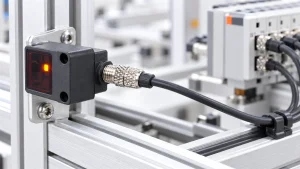
Soulin’s waterproof circular connector range includes M5, M8, and M12 options for industrial automation and field wiring. When a standard circular connector is a near fit, the custom review focuses on cable structure, molded or potted construction, shielding, locking method, and termination requirements.
Getting the Interface Right on the PCB
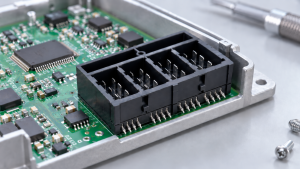
A connector can be electrically correct on paper and still force a board respin when the footprint, pitch, keep-out zone, or mating direction conflicts with the enclosure. For a custom or semi-custom board-mount connector, lock the pinout table before the footprint. Record signal, power, ground, current, voltage, creepage or clearance needs, and test point access per pin.
Place ground pins near sensitive or high-speed signals where the layout needs return path control. Use through-hole mounting when the connector will face cable pull, vibration, or repeated mating. Use surface mount when space is tight and the enclosure stabilizes the connector.
Before release, confirm creepage and clearance for the highest voltage on the connector. A DFM review before the first article inspection catches many issues that otherwise appear after tooling, sampling, or PCB fabrication. This process is covered in more detail in Soulin’sPCB pin connector design guide for pinout, pitch, and layout.
From Prototype to Production: What Happens After the Quote
After approval, the connector still has to survive manufacturing as a finished part or cable assembly. Soulin’s process moves from drawing and BOM review to first samples, inspection report, customer testing, and production release. For harness projects, the workflow adds wire cutting, stripping, terminal crimping, harness board layout, electrical testing, and final inspection. The useful RFQ package includes the drawing, BOM, connector part numbers, wire gauge, cable OD, pinout, target IP rating, current per circuit, and required tests. Crimp height, pull-force, continuity, insulation resistance, and visual inspection catch the defects that are cheapest to fix before installation. Our cable harness assembly process guide shows what to prepare before quoting
Soulin data point: RFQ to production in practice
Soulin’s OEM connector services give a concrete benchmark for the timeline engineers should plan around. The company says standard prototypes can be delivered in 3 days, with select items available for 48-hour express sampling; urgent requests get a feasibility check within 4 hours. On the production side, Soulin reports 95% automation, material logistics for million-unit orders, and flexible multi-batch production runs. Quality control is built into that handoff: every product goes through 100% CCD automated inspection, plus in-house reliability tests covering thermal, vibration, and humidity conditions.
For an RFQ, those numbers turn into a practical checklist. Send the connector size, application, annual quantity, target sample date, batch schedule, and required reliability tests at the first request, not after the quote. That gives the supplier enough context to judge whether the project is a quick prototype, a modified standard part, or a true custom connector that needs tooling and production planning.

Where Custom Connectors Actually Get Used
Automotive, industrial automation, outdoor equipment, smart devices, new energy systems, and instrumentation all create custom connector demand. The design driver changes by application.
Automotive electronics push the design toward vibration resistance, thermal cycling, stable locking, and connector-to-harness sealing. Interior-module connectors do not automatically survive under-hood conditions, even when the pin count and current rating look similar.
Industrial and outdoor equipment place more pressure on ingress protection and mating-cycle life. Factory sensors, actuators, and I/O modules get disconnected for maintenance more than many sealed automotive connectors. When the duty cycle includes maintenance disconnects, start with families that already have known sealing, locking, and mating-cycle data. Soulin’s automotive connector range and M5, M8, and M12 waterproof circular connector series provide standard or modified bases for custom work.
Working With a Custom Connector Supplier
A useful supplier conversation starts with the test plan, not only with the 3D file. Ask which checks will be run on the first sample, which values will be reported before and after stress testing, and which standard or customer specification controls acceptance.
At Soulin, engineers map the connector to the real application before changing tooling. Automotive projects put the spotlight on lock strength, terminal retention, sealed connector-to-harness assembly, and material choice for vibration and temperature cycling. Factory and outdoor equipment shifts the review to IP-rated sealing, shielded transmission, panel mounting, anti-loosening features, and gold-plated contacts for stable low-level signals. In new energy systems, the review covers pinout, latch structure, PCB stacking height, harness routing, creepage or clearance, and control-unit packaging for BMS, EV charging, or power-control assemblies.
Once the solution is confirmed, Soulin moves through engineering evaluation, quotation, first-sample build, inspection reporting, customer testing, and mass production. The strongest first-sample report shows measurable results, not only pass/fail wording: dimensional inspection, plating thickness, continuity, insulation resistance, dielectric withstand where required, pull-force or terminal retention, mating/unmating force, temperature rise at rated current, mating-cycle checks, and environmental checks such as thermal cycling, humidity, vibration, and salt spray when the application calls for them.
FAQs
Standards and test references
IEC 60529: Degrees of protection provided by enclosures (IP Code) – base IP-code reference for general electrical enclosures.
ISO 20653:2023: Road vehicles – Degrees of protection (IP code) – use for road-vehicle electrical equipment and IP6K/IP9K-type requirements.
ZVEI TLF 0214: Validation of Low Voltage Automotive Connectors – a non-binding ZVEI guideline for automotive connector validation up to 60 V DC.
ANSI/EIA 364H-2025 / EIA-364 series: Electrical Connector/Socket Test Procedures Including Environmental Classifications – use for connector electrical, mechanical, and environmental test methods such as low-level contact resistance, vibration, humidity, thermal shock, temperature rise, and pull-out checks.