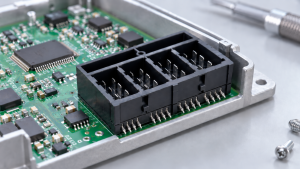
A box header links parts of your PCB and gives a safe, strong connection. Its plastic cover protects the metal pins and helps you line up connectors right. This setup helps you avoid mistakes when putting things together. When it has a cover to guide the connection, people call it a Shrouded Header. You can find box headers in board-to-board and wire-to-board setups.
Tip: A box header helps stop wrong connections and keeps your electronics working well.
Key Takeaways
Box headers make connections strong and safe on PCBs. They help stop mistakes when putting things together.
There are different box headers, like shrouded and right-angle ones. Each type helps with different jobs in electronics.
Good pin setup makes signals better and lowers noise. This helps your electronics work well.
Box headers can be used in many devices. You can find them in phones and cars. They help things work right.
Picking the best box header saves time and money. It makes connecting and removing parts easier.
Box Header Basics

Structure and Types
A box header is a connector that helps you make reliable connections on your printed circuit board (PCB). You see it as a row or rows of metal pins surrounded by a plastic box. This box, or shroud, keeps the pins safe and helps you line up connectors the right way. You often use a box header when you want to connect two PCBs or attach a ribbon cable.
You will find several types of box headers in electronics. Each type has a special structure that fits different needs. Here is a table to help you see the main types and what makes them unique:
Type of Header | Distinguishing Features |
|---|---|
Shrouded Header | Plastic guide box prevents incorrect placement and mismating. |
Straight Header | Pins arranged in a straight line for standard, simple connections. |
Right-Angle Header | Pins bent at 90 degrees, saving space and allowing connections from the side. |
Surface Mount Header | Sits flat on the PCB, giving you a low-profile connection. |
Dual Row Header | Two rows of pins for more connections in a small area. |
Stackable Header | Lets you stack headers, increasing how many connections you can make. |
Breakaway Header | Breaks into smaller sections, so you can pick the pin count you need. |
Wire-to-Board Header | Connects wires straight to the PCB for easy assembly and repair. |
Tip: When you choose a shrouded header, you get extra protection against plugging in the connector the wrong way. This helps you avoid mistakes and keeps your circuits safe.
You might hear people use different names for these connectors. For example, a shrouded header always has a plastic box around the pins. A straight header has pins that stick straight up. A right-angle header bends the pins at a 90-degree angle. A surface mount header sits flat on the board. Each variant fits a different job, so you can pick the one that matches your project.
Pin Configurations
Pin configuration means how the pins are arranged inside the box header. You can find single-row or dual-row headers. Dual-row headers give you more connections in the same space. The way you arrange the pins can help your signals stay strong and your board work better.
Here are some tips for setting up your pin configuration:
Interleave ground pins between signal pins to reduce noise.
Place single-ended signal pins next to ground pins for better signal quality.
For differential pairs, keep the positive and negative pins side by side.
Do not overlap differential pins across rows.
Connect unused pins to ground to avoid interference.
Some box headers, like the PowerTube HVP-HD 1400, can handle very high currents—up to 580 amps. This makes them a good choice for jobs where you need to move a lot of power without overheating.
You also find different pin counts in box headers. Standard pin counts work well with ribbon cables and insulation-displacement connectors. Shrouded headers often have a square notch in the plastic box. This notch stops you from plugging in the connector the wrong way.
Pin Count | Application Description |
|---|---|
Standard | Used with insulation-displacement connectors for ribbon cables. |
Shrouded | Prevents incorrect placement due to a square notch in the shroud. |
Note: If you work with high-speed data, some box headers support speeds up to 100 gigabits per second. This makes them useful for advanced electronics like digital displays and smart devices.
You can see box headers in many places, from smart home devices to medical equipment. Each type and pin configuration helps you build a safer, more reliable electronic system.
Box Header Connectivity
Box headers help you join parts of your electronics. You use them for board-to-board and wire-to-board links. These connectors follow set designs, so your work is easier and safer.
Board-to-Board Connections
A box header lets you connect two PCBs together. This is common in projects with many layers. The box header gives a strong and steady link. It helps you line up the boards right. This keeps signals clear and power steady.
Here is a table that explains why box headers are good for board-to-board links:
Feature | Description |
|---|---|
Latch-Free Design | Easy to use and fits with standard IDC cables. |
Compact Structure | Fits in small spaces, great for crowded boards. |
Reliable Performance | Keeps signals and power steady. |
Cost-Effective | Costs less than many other connectors, so you save money. |
Versatile Mounting | Works with SMT, DIP, and bent pins for different boards. |
Wide Temperature Range | Works from -40℃ to +105℃, so it fits many places. |
Current Transmission | Handles 0.5A-3A, with low resistance for better results. |
You can connect boards in different ways. Some ways are plug-in, mechanical, welding, or bayonet. Each way is good for a different job. Plug-in is fast and simple. Welding makes a strong, lasting bond.
Tip: Always check that Pin 1 matches on both boards. This helps you avoid mistakes and keeps your project working well.
Wire-to-Board Connections
A box header also lets you join wires to your PCB. You often use an IDC box header with a ribbon cable. The ribbon cable has many wires side by side. This makes it easy to connect many signals at once. You see this setup in computers, control panels, and other machines.
Here is a table that lists features of box headers used with ribbon cables:
Feature | Description |
|---|---|
Housing Pitch | Common sizes are 2.54 mm, 2.00 mm, 1.27 mm, 1.00 mm, and 0.80 mm. |
Design Types | Low profile, tall, and high-density choices. |
Orientation | Vertical and right-angle types for different setups. |
Termination Types | Through-hole, surface mount, mixed, and press-fit options. |
Row Configurations | Single, double, triple, or four rows for more links. |
Customization | You can order special sizes or features for your needs. |
You find box headers in many areas, like telecom, cars, and factories. They use standard pitches, like 2.54 mm, so they fit many PCBs and parts. The strong design keeps connections safe, even if the device moves.
Note: When you design your board, keep the real parts close. This helps you check the fit and make sure everything lines up.
Box headers are special because they follow industry rules. This means you can use them in many projects without worry. You get a connector that is easy to use and saves you time.
Box Header Design
Shrouding and Polarization
Shrouding is an important part of box header design. The plastic shroud goes around the pins and keeps them safe from harm. You see this in shrouded headers and shrouded pin headers. The shroud does more than just protect the pins. It helps guide the connector into the right spot. This means you cannot plug it in the wrong way. This lowers the chance of making a mistake, which is very important for safe and strong connections.
If you use a fully shrouded box header, you are less likely to make a mistake. This is very helpful when you have lots of board-to-board connections close together. The shroud keeps the pins lined up and helps your signals stay strong. You do not have to worry about bent pins or bad connections.
Polarization is another key design feature. It means the connector only fits one way. The plastic housing usually has a notch or key. This notch matches a slot on the other connector. You cannot connect it the wrong way, even if you try. Polarization stops you from making mistakes that could hurt your board. You do not need to read labels or instructions. The design itself keeps your connections safe.
Tip: Always look for the notch or key on your connector. This small part can help you avoid big mistakes.
Preventing Misconnection
Box headers use special design features to stop wrong connections. These features help you connect things the right way every time. Here is a table that shows how different design parts help you avoid mistakes:
Design Feature | How It Prevents Misconnection |
|---|---|
Foolproof Mating | Only lets the connector fit one way, stopping mismating. |
Reliable Socket Contacts | Keeps electrical connections steady and lowers errors. |
Unique Pin Configurations | Uses special pin layouts to stop mixing up signals. |
You also see error-proof designs in many connectors. These designs stop you from connecting things upside down or in the wrong place. Some connectors use different shapes or sizes for each spot. This makes it almost impossible to make a big mistake.
Shell protection keeps dust, shaking, and accidents away from the pins.
High-density pin layouts let you fit more connections in a small space.
Materials that handle high heat help your connector last longer.
Note: In places like factories or cars, connectors face tough conditions. The strong housing in a box header keeps your connections working, even when things get rough.
Box header designs are special because they protect the pins and keep your connections safe. The shroud and polarization work together to stop wrong connections. You get a connector that is strong and reliable. This makes it a good choice for many electronic projects.
Applications
Common Uses
Box headers are used in lots of electronics. They help you make safe and fast connections. You can find them in many places, like:
Mobile devices and wearables
TVs, set top boxes, and monitors
Laptops, tablets, and computers
Appliances and white goods
Printers and scanners
Cars use these connectors in many parts. They help with airbags, brakes, cameras, and dashboards. You also see them in car audio, lights, navigation, and power seats. Factories use them in machines, control panels, and sensors. These examples show that box headers are useful and important in today’s technology.
Note: These connectors work well in hard places, like cars and factories, because they can handle shaking and heat.
Why Choose Box Headers
You need a connector that is simple, strong, and saves money. Box headers give you all these things. Their design lets you connect and disconnect boards fast. You do not need special tools or training. This makes fixing and upgrading easier.
Here is a table that explains why people like these connectors:
Advantage | Description |
|---|---|
Cost-effectiveness | Standard shapes and sizes help lower how much you spend. |
Reliability | A tight fit keeps connections safe and stops devices from failing. |
Ease of use | Easy to put in and take out, so you save time when testing or fixing things. |
Box headers last a long time. You can change or fix them without soldering, which saves time and work. Finding problems early helps your devices last longer. When you pick a box header, you get a connector that is good for both quality and saving time.
Box headers help you make safe and standard connections on your PCB. The plastic guide box has a square notch. This notch helps you plug in connectors the right way. It stops you from putting them in wrong and keeps your circuits safe. Box headers work well and are easy to put together. You will make fewer mistakes when you use them. If you know how box headers are made, your electronics will last longer and cost less. Pick box headers for your next project. They make your work easier and more reliable.