You’re deep into a new PCB design, and it’s time to figure out your wire connections. You open up a component catalog and immediately hit a wall of jargon. You see parts called “headers” and others, similar-looking parts called “wafers.” One is cheap, the other costs more. Why?
If you design PCBs, handle buying stuff, or just love electronics, you’ve likely hit this annoyance – manufacturers often call the same part by different names, particularly if they’re based in separate parts of the world.
Time to clear things up once and for all. First off, we’ll break down what each term actually means. Then, you’ll see how they differ in actual use. After that, we’ll walk through exactly where each option makes the most sense.
Defining the Terminology: What Are We Talking About?
Usually, mix-ups happen because one word covers a lot while the other focuses on just a small part.
The “Header”: Your Go-To General Connector
Imagine a pin header as a simple tool for linking things. Basically, it’s a row of metal pins stuck in a small plastic frame. You’ll find them everywhere – cheap and easy to get. Instead of fancy parts, they use a straightforward design. The familiar breakaway header with 2.54mm pin spacing is the king of the prototyping world, fitting perfectly into breadboards and accepting standard jumper wires.
Headers can be completely bare (unshrouded) or have a simple four-sided plastic wall (box header). Their job is simple: create a point where something else can connect, whether it’s another board or a temporary wire.
For high-quality pin headers and box headers suitable for both prototyping and production, manufacturers like SOULIN provide a wide range, including male/female pin headers and ejector headers.

The “Wafer”: The Purpose-Built Specialist
So, what’s a “wafer”? The term is heavily used by major Asian connector companies like JST and Hirose, and countless others who make compatible parts.
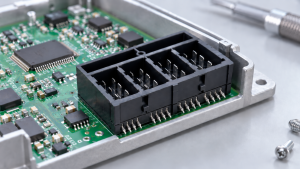
A wafer is the industry’s answer to the pin header’s weaknesses. It’s a specific type of header that is built for a single purpose: to create a reliable wire-to-board connector type. It’s one half of a dedicated connection system. The wafer gets soldered to the PCB, and it’s designed to accept a very specific partner—a plastic housing that clips onto the ends of your wires.
The easiest way to think about it is this: A wafer is a specialized, shrouded header designed for a secure connection with a wire housing.
Leading manufacturers like SOULIN Electronics specialize in reliable wafer connectors and compatible wire-to-board systems, ensuring polarization and locking features for professional applications.

Physical & Mechanical Differences You Can See and Feel
Here’s where the two parts really diverge. Their physical features directly impact how reliable and safe your final product will be.
Polarization & Keying (How to Avoid Fried Circuits)
A wafer’s biggest advantage is that it forces you to plug it in correctly. The plastic shroud around the pins is shaped with unique slots or clipped corners. This is called polarization, or keying. The mating wire housing has the exact opposite shape, so it can only plug in one way.
- Headers: Offer zero protection here. You can easily plug standard jumpers or connectors in backward. This reverses the voltage polarity and can instantly fry your components—the dreaded “magic smoke.”
- Wafers: The keyed design makes incorrect assembly physically impossible. For any product you plan to manufacture and sell, this feature isn’t just nice to have; it’s essential for preventing expensive errors.

Locking Ramps and Connection Security
How securely does it stay plugged in? A simple friction-fit on a pin header is fine on your desk, but it’s a liability in a product that moves.
- Headers: The connection depends entirely on the friction of the metal contacts gripping the pin. Vibrations or a simple tug can work it loose over time.
- Wafers: Most wafer-style wire-to-board connector systems use a friction-lock or latch mechanism that provides secure retention under vibration, making them suitable for production and industrial environments. A small, flexible ramp on the housing actually “clicks” into place on the wafer. This latch means the connection can handle bumps, drops, and vibrations without failing.
SMT vs. Through-Hole Mounting
You’ll find both headers and wafers in Surface-Mount (SMT) and Through-Hole (THT) styles. For connectors that will see plugging/unplugging cycles, the THT versions offer much better mechanical strength, as their pins are anchored all the way through the board. SMT versions are great for saving space in dense, compact designs.

A Practical Selection Guide: When to Use Which?
So, how do you choose? It’s not about “good” vs. “bad.” It’s about the right tool for the job.
Use Pin Headers When
- You’re Prototyping: The ease of use with breadboards and jumper wires can’t be beaten during development. They are perfect for testing ideas quickly.
- Connecting Boards Directly: Stacking one board on top of another is a perfect job for male and female headers.
- Creating Debug Ports: A simple header is a low-cost way to add a programming or diagnostics port (like ISP or JTAG) that will only be used occasionally by a technician.
- Cost is Everything: In a non-critical, low-cost project, a simple header might be good enough.
Use Wafers When
- You’re Shipping a Real Product: For any consumer, commercial, or industrial device, the reliability of a wafer is the professional choice.
- Assembly Can’t Fail: The polarization prevents assembly line errors and customer-caused damage. It’s non-negotiable for mass production.
- It’s in a Tough Environment: For anything that moves, vibrates, or gets handled roughly (like cars, drones, or industrial machines), a locking wafer is your safe choice.
- You Need a Clean Wire Harness: Wafers and their mating housings are designed to create clean, secure, permanent wire harnesses.
For any consumer, commercial, or industrial device, the reliability of a wafer is the professional choice. SOULIN offers robust wafer connectors certified for automotive and industrial use (IATF 16949), making them ideal for vibration-resistant and secure wire-to-board connections.

Conclusion
The “wafer vs. header” choice becomes simple when you understand the terminology. A header is your versatile tool for prototyping and simple jumpers. A wafer is your reliable specialist for creating secure, error-proof wire-to-board connections in a finished product. By choosing the right component for the right stage of your design, you ensure your project is both easy to develop and reliable in the long run.
For high-quality headers and wafers that meet global standards, explore the full range at SOULIN’s product page or learn more about the company.