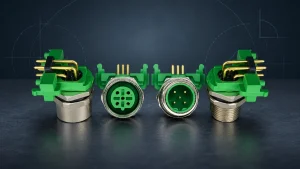
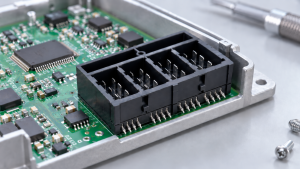
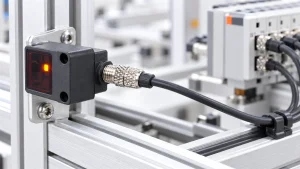
M12 connectors use mechanical coding to prevent the wrong cable or device from being connected. The code is created by the keyway shape inside the connector. A-coded, D-coded, X-coded, T-coded, L-coded, S-coded, K-coded, and B-coded M12 connectors may all share the same M12 thread size, but they are designed for different signal, data, and power applications.
Buy M12 connectors by code and application
soulin supplies M12 A, B, D, X, S, T, L and K coded connector options for sensors, industrial Ethernet, automation, and power systems.
The fastest way to choose the right M12 connector is to start with the application:
- Use A-coded M12 for sensors, actuators, general automation signals, and some DC power connections.
- Use B-coded M12 for fieldbus systems such as PROFIBUS.
- Use D-coded M12 for industrial Ethernet up to 100 Mbps.
- Use X-coded M12 for high-speed industrial Ethernet, including Gigabit and 10 Gigabit applications.
- Use S-coded, T-coded, L-coded, and K-coded M12 for power applications, depending on AC/DC power, current requirement, and equipment standard.
This guide explains the main M12 coding types, common pin counts, applications, selection rules, and mistakes to avoid.
Quick M12 Connector Coding Chart
| M12 Code | Typical Pin Count | Main Use | Typical Application |
|---|---|---|---|
| A-coded | 3, 4, 5, 8, 12, 17 | Sensors, actuators, signal, general DC | Proximity sensors, photoelectric sensors, I/O modules |
| B-coded | 5 | Fieldbus communication | PROFIBUS and some legacy automation networks |
| D-coded | 4 | Industrial Ethernet | PROFINET, EtherNet/IP, 100 Mbps Ethernet |
| X-coded | 8 | High-speed Ethernet | Gigabit Ethernet, 10 Gigabit Ethernet, machine vision |
| S-coded | 3, 4 | AC power | AC motor and power distribution applications |
| T-coded | 4 | DC power | 24 V DC power distribution |
| L-coded | 4, 5 | Higher-current DC power | Compact high-current DC power systems |
| K-coded | 5 | AC power | Higher-power AC drives and equipment |
| Y-coded | Hybrid | Power plus data | Hybrid automation cables and compact device wiring |
Always check the product drawing, rated voltage/current, pin assignment, and mating connector before ordering. Coding helps prevent mismating, but it does not replace electrical verification.
What Is M12 Connector Coding?

M12 connector coding is the keyway design that controls which plugs and sockets can mate with each other. The thread size remains M12, but the internal key shape changes by code.
This matters because different M12 connectors can carry very different signals:
- Low-voltage sensor signals
- Industrial fieldbus signals
- Ethernet data
- DC power
- AC power
- Hybrid power and data
If the wrong connector is forced into a device, it can damage pins, break the keyway, create wiring errors, or connect power to a signal port. For industrial equipment, this can lead to machine downtime or device failure.
A-Coded M12 Connectors
A-coded M12 connectors are the most common M12 type. They are widely used for sensors, actuators, I/O modules, and general automation wiring.
Typical uses:
- Proximity sensors
- Photoelectric sensors
- Limit switches
- Actuator cables
- I/O modules
- Low-voltage signal wiring
- Some DC power applications
Common pin counts:
- 3-pin
- 4-pin
- 5-pin
- 8-pin
- 12-pin
- 17-pin
A-coded connectors are often the default choice when the application is signal or sensor wiring rather than Ethernet or dedicated power. However, pin assignment can vary by device, so the connector code alone is not enough. Always check the wiring diagram.
B-Coded M12 Connectors
B-coded M12 connectors are mainly associated with fieldbus communication, especially PROFIBUS-style industrial networks.
Typical uses:
- PROFIBUS systems
- Fieldbus modules
- Legacy industrial communication networks
Common pin count:
- 5-pin
B-coded connectors are less common in new Ethernet-based systems than D-coded and X-coded connectors, but they are still important in factories with existing fieldbus infrastructure.
D-Coded M12 Connectors
D-coded M12 connectors are used for industrial Ethernet, especially 100 Mbps Ethernet applications.
Typical uses:
- PROFINET
- EtherNet/IP
- Industrial Ethernet devices
- PLC communication
- Machine control networks
- Factory automation equipment
Common pin count:
- 4-pin
D-coded connectors are a common choice when the equipment needs rugged Ethernet connectivity in an industrial environment, but does not require the bandwidth of X-coded M12.
X-Coded M12 Connectors
X-coded M12 connectors are designed for high-speed industrial Ethernet. They use eight contacts and internal shielding separation to support higher data rates than D-coded connectors.
Typical uses:
- Gigabit Ethernet
- 10 Gigabit Ethernet
- Machine vision
- High-speed industrial cameras
- Robotics
- Data-heavy industrial control systems
Common pin count:
- 8-pin
Choose X-coded M12 when the application needs high-speed data transmission and rugged environmental protection. Do not replace X-coded connectors with D-coded connectors if the system requires Gigabit or 10 Gigabit performance.
S-Coded M12 Connectors
S-coded M12 connectors are used for AC power applications. They help separate AC power wiring from signal or data connectors.
Typical uses:
- AC power supply
- AC motor connections
- Power distribution in automation equipment
Common pin counts:
- 3-pin
- 4-pin
Use S-coded M12 when the equipment specification calls for AC power in a compact circular connector format.
T-Coded M12 Connectors
T-coded M12 connectors are commonly used for DC power distribution, especially in 24 V DC automation systems.
Typical uses:
- 24 V DC power
- Field power distribution
- Compact automation equipment
- DC-powered I/O modules
Common pin count:
- 4-pin
T-coded connectors are useful when power and signal connectors need to be separated clearly in the same equipment area.
L-Coded M12 Connectors
L-coded M12 connectors are designed for compact higher-current DC power connections. They are often used where more power is needed than a small signal connector should carry.
Typical uses:
- Higher-current DC power
- Distributed power systems
- Compact automation modules
- Industrial power distribution
Common pin counts:
- 4-pin
- 5-pin
Use L-coded M12 when the application requires a compact DC power connector with a higher current rating than typical sensor connectors.
K-Coded M12 Connectors
K-coded M12 connectors are used for AC power applications that require a dedicated coded interface.
Typical uses:
- AC drives
- AC power distribution
- Industrial equipment power
Common pin count:
- 5-pin
K-coded connectors help separate higher-power AC wiring from signal, Ethernet, and lower-power DC connector types.
Y-Coded M12 Connectors
Y-coded M12 connectors combine power and data in a single connector interface. This can reduce cabling complexity in compact devices, but it also makes correct pinout and cable selection more important.
Typical uses:
- Hybrid power and data wiring
- Compact automation devices
- Equipment where fewer cable entries are preferred
Use Y-coded connectors only when the device and cable system are designed for that hybrid interface.
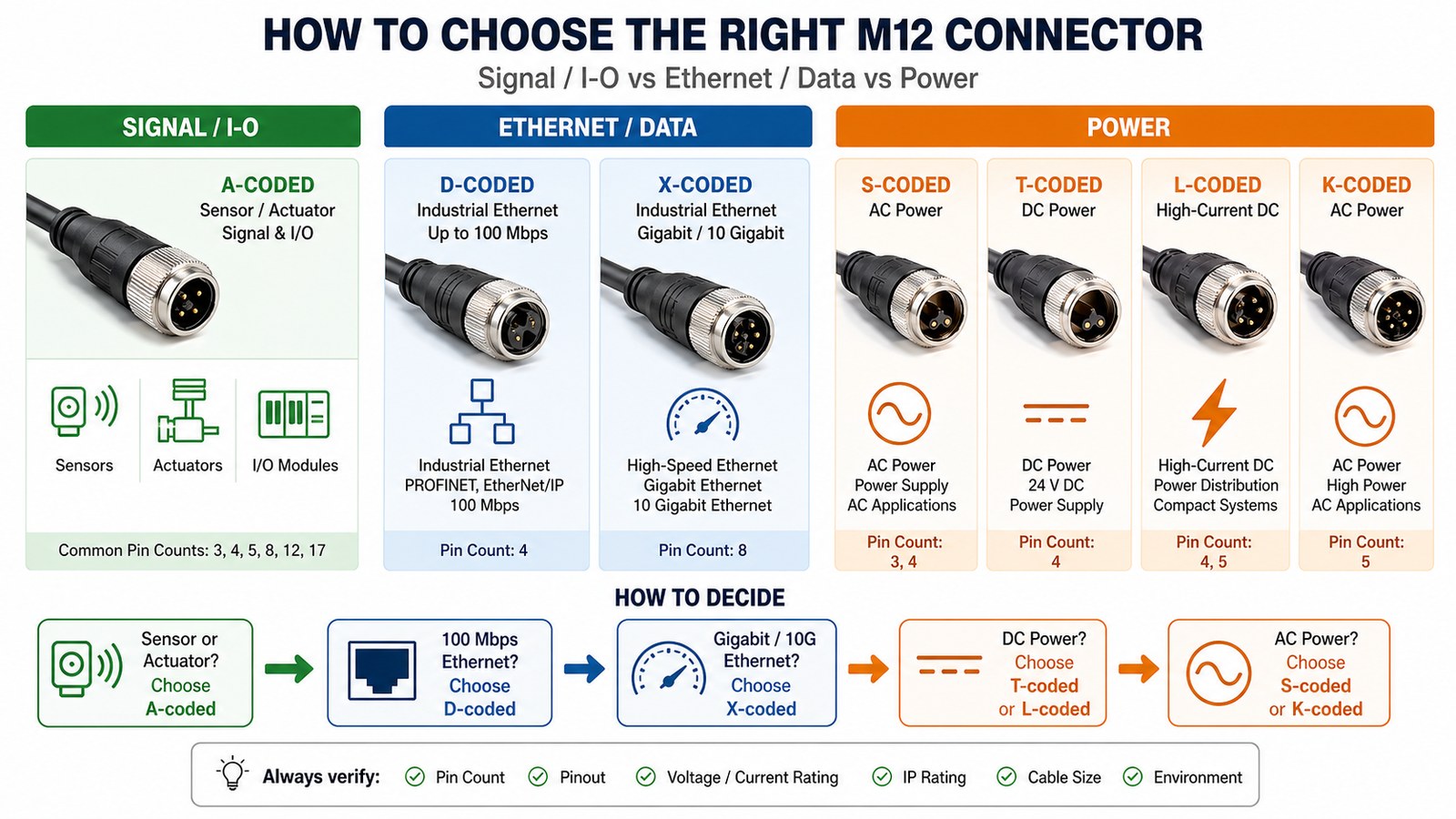
M12 Coding Selection Guide
| Application | Recommended M12 Code | Why |
|---|---|---|
| Sensor or actuator signal | A-coded | Most common automation signal connector |
| PROFIBUS or fieldbus | B-coded | Designed for fieldbus communication |
| 100 Mbps industrial Ethernet | D-coded | Common 4-pin industrial Ethernet interface |
| Gigabit or 10 Gigabit Ethernet | X-coded | Eight-pin high-speed data connector |
| 24 V DC power | T-coded or L-coded | Dedicated DC power interface |
| Higher-current compact DC power | L-coded | Better fit for higher-current DC applications |
| AC power | S-coded or K-coded | Dedicated AC power coding |
| Power and data in one connector | Y-coded | Hybrid interface for compact devices |
M12 Pinout: Why Code Is Not Enough
M12 coding tells you the connector family, but it does not always tell you the complete wiring. Two A-coded M12 connectors can have different pin counts and different pin assignments.
Before selecting or replacing an M12 connector, confirm:
- Connector code
- Male or female interface
- Straight or angled body
- Pin count
- Pin assignment
- Shielding requirement
- Cable outer diameter
- Rated voltage and current
- IP rating
- Operating temperature
- Mating cycles
- Panel mount, cable assembly, or PCB connection style
For industrial applications, check both the device manual and the connector drawing.
Common M12 Connector Mistakes
Mistake 1: Choosing by thread size only
All M12 connectors share the M12 thread concept, but coding, pin count, and electrical rating can be completely different.
Mistake 2: Treating A-coded and D-coded as interchangeable
A-coded is usually for signals and sensors. D-coded is used for industrial Ethernet. They are not the same application class.
Mistake 3: Using D-coded where X-coded is required
D-coded is commonly used for 100 Mbps Ethernet. X-coded is used for higher-speed Ethernet applications. If the network requires Gigabit or 10 Gigabit performance, check the cable and connector specification carefully.
Mistake 4: Ignoring current rating
Power-coded M12 connectors are designed for power applications. Do not use a signal connector for a power circuit just because the connector physically fits.
Mistake 5: Forgetting the environment
Industrial connectors may need protection against moisture, oil, vibration, dust, or temperature changes. Check the IP rating, cable jacket material, shielding, and locking reliability.

How soulin Helps With M12 Connector Selection
soulin can support M12 connector selection for industrial automation, sensors, power distribution, and Ethernet devices. If you are choosing connectors for a cable assembly, panel interface, PCB device, or equipment enclosure, send us:
- Connector code needed
- Pin count
- Male/female requirement
- Straight or angled body
- Cable specification
- Voltage/current requirement
- IP rating target
- Application environment
- Drawing or sample photo if available
Our team can help match the M12 connector type to the electrical and mechanical requirements of your application.
Match the M12 code before ordering
Confirm coding, pin count, cable exit, IP rating, shielding, current rating, and mating side before selecting the connector.
FAQ
M12 Connector Coding: Selection and Sourcing Notes
M12 coding is selected by signal type, power level, keyway geometry, pin count, shielding and mating environment. A-code is common for sensors, D-code and X-code support Ethernet use cases, while S, T, L and K codes are typically reviewed for power interfaces.
Sourcing next step
- waterproof circular connector category: Use this category when the design needs M8/M12 circular connectors for sealed industrial interfaces.
- M12 connector replacement and custom review: Send the old part number, code, pinout, mounting details and sample for cross-reference or OEM/ODM review.
Engineering checklist before RFQ
- Confirm code, gender, pin count, shield requirement, mounting style and cable or PCB termination before sampling.
- Check whether the application needs field-attachable, molded cable, panel mount or PCB mount construction.
- Match IP rating, current rating, voltage rating and temperature range against the final equipment environment.