If you’ve ever taken apart an electronic device or prototyped with an Arduino, you’ve undoubtedly encountered the 2.54mm pitch pin header. They are one of the most ubiquitous components in the electronics world. Tiny metal pins lined up like soldiers – they’re basic, sure, yet that’s exactly what makes them useful. Ever wonder why this particular piece took over? Also, how do you know which version works best?
This guide takes a close look at 2.54 mm pitch pin headers – what makes them common, along with the various forms and dimensions out there. Instead of just listing types, we’ll go over each one step by step. Once done, you’ll understand which connector fits your build, be it a rough draft or something ready for use.

The 2.54mm Pitch Header: The Standard for a Reason
Here’s why 2.54mm pitch pin headers pop up everywhere – they just work, plain and simple. People tend to pick them for circuit builds. These types of pin headers get popular because builders trust their steady advantages, time and again.
- Breadboard fit is what counts – key spacing at 2.54mm, close to 0.1 inch. That’s why pins slip easily into standard breadboards or perfboards, no issues. This makes folks call it a breadboard-friendly header instead. Testing new circuits? Fast now – no worries.
- These pins feel tough – thick, sturdy, nothing flimsy anywhere. They don’t shake or wiggle, which makes inserting them seem reliable. You won’t worry about pieces breaking or bending while using them. This is way better than the small, fragile ones you see around.
- Soldering’s a breeze – once you’re ready to lock things down, that tiny 0.1-inch gap gives plenty of room to slip the iron in smoothly. So instead of messy blobs bridging close pins, everything stays clean and tidy.
- Folks pick it ’cause it’s all over – mass-produced stuff means cheap prices, so nearly every shop carries these bits. No need to wander far when you want one.
This mix of traits turns the 2.54mm pitch pin header into a top pick for Arduino boards – alongside shields – and countless gadgets out there
A Universe of Options: Exploring 2.54mm Header Configurations
At first glance, the number of options can feel endless. But it’s actually pretty simple once you break it down by a few key features.
By Number of Rows
- Single Row: Just like it sounds, a single line of pins. These single-row headers are your go-to for simple wire-to-board connections or breaking out pins from a microcontroller.
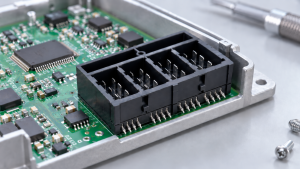
- Dual Row: When you need more connections in a compact space, this double row header is the answer. It’s often used for wide ribbon cables or for creating denser board-to-board links.
- Triple Row: For seriously complex gear, you might see triple-row headers. They pack the maximum number of pins into a small footprint for advanced applications.
By Mounting Type
- Through-Hole (THT): The classic style is what most people picture. A THT 2.54mm header has long pins that go through holes drilled in the circuit board and are soldered on the back. This creates a super-strong mechanical connection, which is great for any connector you’ll be plugging things into often.
- Surface Mount (SMT): The alternative is Surface Mount. Here, the pins are bent and sit on pads on the surface of the board. SMT headers are primarily for automated assembly lines where robots place all the parts.

By Orientation
Straight (Vertical): The pins point straight up, 90 degrees from the board surface. It’s the obvious choice for stacking boards vertically or when you need easy top-down access.
Right-Angle: This one is a real space-saver. The pins are bent 90 degrees to run parallel with the board. A right-angle header is perfect when a cable or another board needs to connect from the side.
U-Shaped: This is a more specialized style. The pins form a “U,” allowing you to connect a mating part parallel to the board edge it’s mounted on.
By Function
- Standard Headers: These are the plain vanilla headers for everyday connections.
- Elevated / Stacking Headers: You can spot these by their longer pins and tall plastic spacers. An elevated stacking header is made to create a specific gap between two parallel boards. This is exactly how Arduino shields stack onto the main board.
Key Technical Specifications
Appearance isn’t the whole story. What’s inside matters more – manufacturers test those details hard. These numbers? Just rough starting points for common brass or copper alloy models. Always check the maker’s sheet for your exact model before use. Ratings shift – material type, coating, or pin choice can push them up or down.
| Specification | Typical Value & Range | Notes |
|---|---|---|
| Pitch | 2.54 mm (0.1″) | Defined by IPC standards as the baseline for many through-hole components. |
| Current Rating | 1.0 A to 3.0 A per pin | Crucial: This is highly dependent on material (brass vs. phosphor bronze) and plating. Rating often applies to a single pin; using multiple pins for high current requires derating due to heat. Always confirm the derating curve in the datasheet. |
| Voltage Rating | 250 V AC/DC (Typical) | Known as the Dielectric Withstanding Voltage, it’s the maximum voltage the insulator can block before failure. Derate for high-altitude applications. |
| Pin Size (Square) | 0.64 mm x 0.64 mm (0.025″) | This is the standard post size that fits most female sockets and breadboards. |
| Insulator Material | PBT, PA6T, LCP. All UL94V-0 rated. | PBT is a cost-effective standard. PA6T or LCP are high-temperature plastics required for SMT/reflow soldering processes. The UL94V-0 rating signifies the material is flame-retardant and self-extinguishes within 10 seconds. |
| Operating Temp. | −40∘C to +105℃ | This range is typical for PBT insulators. High-temperature materials (PA6T/LCP) can extend this to +125°C or higher. |
Industry Standards and Compliance: A Mark of Quality
While getting parts – especially if you’re selling something – always check they follow essential industry rules. That way, things stay safe, work well, or reach more countries. Trusted 2.54mm pin headers usually stick to:
RoHS (Restriction of Hazardous Substances): A European Union directive that restricts the use of specific hazardous materials found in electrical and electronic products.
REACH (Registration, Evaluation, Authorisation and Restriction of Chemicals): Another EU regulation managing the risks posed by chemicals to human health and the environment.
UL Recognized Part (RU sign): The flipped UR icon means this piece got approved by Underwriters Laboratories (UL) to work inside a bigger device that’s already UL listed. It shows the part meets solid safety standards, so it can be trusted in full systems built under UL rules.
Pick items carefully – make sure the seller follows those rules we talked about earlier when using their goods.
At SOULIN, you can trust how we make things. Our work follows strict standards – like ISO 9001:2015, ISO 14001, and IATF 16949. Every item passes UL checks, meets RoHS and REACH rules, plus has EC REP approval.
Mating Connectors: Completing the Connection
A pin header is useless on its own. You need something to plug into it. This is usually one of two things:
- Female Sockets (Female Headers): These are essentially the inverse of the pin header, designed for board-to-board connections. They create a secure and removable link between two PCBs.
- Crimp Housings: These plastic housings are where you build custom cables. You take a wire, “crimp” a metal contact onto the end, and then push that contact into the housing.
Conclusion
That 2.54mm pitch pin header isn’t only plastic with metal bits – actually, it’s key to many circuits, fixes tricky issues, yet rarely gets noticed.
Once you get how rows, mounts, and orientations differ, guessing ends – picking the right piece gets real. This part’s relied on by builders and tinkerers worldwide, so knowing what makes it tick matters.
At SOULIN, we manufacture a comprehensive range of 2.54mm pitch pin headers to meet the rigorous demands of both prototyping and high-volume production. Whether you need a standard configuration or a completely custom solution, our engineering team is ready to help you select the perfect connector.
Explore our 2.54mm Pin Header solutions or contact us today to discuss your project’s unique requirements.